Showing posts with label Book Review. Show all posts

Sunday, February 9, 2014

The Bridges of Madison County by Robert James Waller


This book is a hands down classic love story. It even became one of the most classic love story movies adapted on the big screen starred by cinema big-weights Meryl Streep and Clint Eastwood. I’ve always wanted to read this book. I’ve somehow penciled it in my mind, but it just didn’t materialize. And I’ve seen the movie played in HBO a couple of times (years ago!) but I made a conscious effort to skip it because I had to be honest, it looked pretty “country” and boring. All I know about The Bridges of Madison County before reading the book was that it’s a love story of two middle aged folks, which I wouldn’t assume really be compared to a rush of a roller coaster ride.

Boy was I wrong. The book proved me wrong!

If the book is about a quiet love story of two middle aged folks in the country, I was a bit surprised that it was not a bore at all. The novel was short technically a novella of 154 pages in E-Book, but the words and pages were used wisely. There were no lengthy histories of characters nor was there any excessively flamboyant use of narration. It was straight to the point, concise yet very poetic. One of the no-nonsense love stories I’ve ever read without losing the sense of passion and raw emotion. Being straight to the point, the book is very easy to read, but conversations between these two people and their raw thoughts and emotions told in a 3rd person perspective supply the poetic high and romance that we rarely see nor experience in this day and age. The words of Robert Kincaid to Francesca captured me that no Edward Cullen could utter. You’ll immediately feel affinity and support for Francesca who was initially a complete stranger to the reader who transformed from being a simple, country and plain housewife to an individual woman who has dreams and inner strength. Robert Kincaid is not your typical prince charming either. He doesn’t impose himself nor tries to sweep you off your feet. He just does with his innate independence, gentleness, sincerity and intellect. Beneath his character’s strength and passion, is still a man of control.
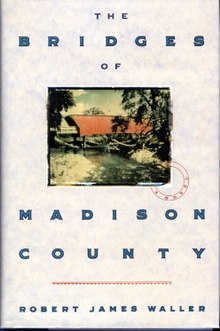


The story started off with Robert Kincaid’s journey as a photo-journalist. From the get-go, we find that he is a unique individual and very independent. In one of his trips to cover wonderfully constructed bridges all over the country, he crossed paths with Francesca, a farm wife, who was incidentally sitting on her porch enjoying her solitary day. Francesca ended up assisting Robert Kincaid to get to the Roseman Bridge and thus the beginning of their 4-day romance. 

I have mentioned that the book was short, but from their initial observation of each other and their first interaction, the reader could get to feel the intensity of their attraction. But it’s not the interaction of teenagers and those individuals only up for a fleeting romance. Their attraction is deep and controlled. Probably this wouldn’t have worked well in 20 something characters when they still have the world at the palm of their hand. What makes this romance interesting is that here are two middle aged people who have a good sense of who they are and who have their own responsibilities and their own ‘lives’ to lead. The gestures and scenes in the book are magnified. I loved the scene when Francesca was in Robert Kincaid’s truck having a cigarette. I knew they had to be together!

Robert Kincaid pulled a pack of cigarettes from his shirt pocket, shook one halfway out, and offered it to her. For the second time in five minutes, she surprised herself and took the cigarette. What am I doing? she thought. She had smoked years ago but gave it up under the steady thump of criticism from Richard. He shook out another one, put it between his lips, and flicked a gold Zippo lighter into flame, holding it toward her while he kept his eyes on the road.

      She cupped her hands around the lighter to hold the wind in abeyance and touched his hand to steady it against the bouncing of the truck. It took only an instant for her to light the cigarette, but that was long enough to feel the warmth of his hand and the tiny hairs along the back of it. She leaned back and he swung the lighter toward his own cigarette, expertly forming his wind cup his, taking hands off the steering wheel for no more than a second.

With Francesca’s invitation for Robert to join her for supper and quiet company, it already gives the reader a glimpse of how powerful she can be. Francesca is a woman of ideals, responsibilities and morale, but she is also a woman capable of having dreams and passion. You know she will sin, but the reader would immediately fall for them so much that her husband (Richard) can just very well be a figment or a trivial fact of her life. While beneath Robert Kincaid’s independent and aloof persona, comes his gentleness and willingness to be tied down.

And did I mention that the most interesting part of this is that they were only together, exhibiting deep physical relationship and care, for only four days. They met on a Monday and ended their love affair on a Thursday. But what’s amazing is that in those four days we know that they should be together and no time was wasted. It was like finding your soul mate after years of searching and wondering but after the fourth day, it is inevitable to say goodbye. Robert Kincaid asked Francesca to tell him to make things right. He could be man enough to talk to Francesca’s husband and take her with him. But Francesca is a woman of responsibilities and sensitivity. She knew their affair might only last for four days but her relationship with him will last forever without tainting or giving any burden to her family or limiting Robert Kincaid’s independence.  On the fourth day of their separation, they carried heavy hearts and they both shed quiet tears, but probably that’s what sets them apart. Their passionate affair, their whirlwind romance, romance of a middle aged people, transcends time and space. They have the strength to endure pain and sacrifice. Their view of love transcends physicality and acknowledgement.

They never got together again, but the readers know that after their four-day affair, they already had each other forever. Francesca carried on being a wife and a mother contented with memories, old photographs and that pink dress she wore on that night they danced in her kitchen. While Robert Kincaid continued to be vagabond, taking pictures and never forgetting her.  Until their respective deaths, they knew that they had each other and the memories of those four days of happiness and passionate love were enough.

Before one starts to read their story, there is a chapter in the book that serves as a form of a caveat. The writer mentioned that for one to appreciate this story, one has to have an open mind. Romantic cynics and realists might not be able to ingest the words and accept that the memories of a four day romance were as real and as true as it can be. This story will reflect the image of our relationships if we indeed have found the Robert Kincaids and Francescas of our lives. It took them years and almost forever just to find each other and yet to separate after four days. But for them it’s enough for at least they know they have found the real love they deserve. 

The Shining Girls by Lauren Beukes


This book came to my reading list because I was searching for the best horror-mystery novels to replenish my collection and this title came up twice. Plus the cover is eerie.

The story turned out to be more than a murder thriller than a paranormal one. Although there is one element that gives a supernatural distinction that sets it apart from the mainstream serial killer fare. The serial killer named Harper can travel through time with an aid of a house he magnificently stumbled upon in Chicago 1930’s. Harper is your typical psychotic serial killer. He kills the girls brutally while leaving relics to identify him by, which is quite egotistic on his part because with his time traveling ability, it’s one to a million that he will be caught unless he is that sloppy. He derives his kick from the gruesome acts and relishes the hunt. He feeds the house with the deaths of “shining girls”, girls who will make a difference in this world. I never quite got the explanation behind this force nor was his history uncovered. He started off as a sick serial killer and ended off as one.


He sets off killing girls in various eras, which gives the book a multitude of settings and landscapes. In some parts, you could empathize with Harper’s sense of power when he can wrong a right, visit places way before his time and witness the rise and fall of a period. One thing that centered on this story is by closing the unfinished loop when he failed to kill one girl named Kirby. Kirby, in her adult years, turned out to be this sarcastic scarred woman out to make sense and hunt her killer while working as an intern in a newspaper bureau. The two main characters, the victim and the killer, perform the confusing search dance hoping to collide with each other and close the gap.

This story is not your typical serial-murder story. At some points, the method of time traveling gives the order of the story complexity and detail. This book needs the reader’s full attention and imagination. It will also not serve answers but questions. What about this time traveling house? Why would the house need deaths of the shining girls? Why is Harper the way he is? Well, it’s best not to ask and embrace these given facts to be able to move on. It’s an interesting book, but it’s not for everybody. I might read it again sometime. It took me almost two weeks to finish it. 

Sunday, January 5, 2014

Book 2 of 2014: Ray Bradbury's Fahrenheit 451


Ray Bradbury’s Fahrenheit 451 was something I bought on an impulse, but something that was safe enough because it’s clearly a no-nonsense book perfect for times when you want things to make sense or you’re in a very intellectual and critical mood. First published in 1953 and garnered the National Book AwardAnd for a book lover, who wouldn’t be captured by the premise of the story? It’s about a fireman who lived in a dystopian future and his main task is to destroy significant objects that provoke enlightenment and individual thought. And these are books. Imagine a pile of written works by genius turned to ashes? Sacrilege! 

The lead is a 30ish fireman named Montag who actually relishes his job as a “fireman,” extremely committed to his duty to JUST follow orders from the futuristic American government, to destroy whatever that was not allowed, hidden books, past records and artworks of renowned artists. At the start of the book Montag’s climactic moment of destruction through fire was intriguing. Here was a man who relishes turning valuable things to ashes. Was it a traumatic past that led him to be a destroyer? Or was this a brainwashed individual of this future government? Or was destroying things as a fireman the only truth he knows?

Through the story he began to meet characters that tickled his existence. He met a young 17-year old woman who seems to stop and notice the details of their world, who is brave enough to ask questions that no one dared looking for answers to. Slowly his life is illuminated and consciousness starts to flow through, challenging his mind. The Hound, a mechanical beast at work, Beattie his suspecting superior, Mildred his wife who is actually a stranger, the woman who was burnt that turned the point around for Montag, Faber an old ally and Granger an exiled book lover.  

This novel reminds me of other plots set in dystopian worlds that represses a part of humanity until one person becomes enlightened, breaks through the cycle and challenges it. One interesting concept that I’ve read in this story was that previously written books by the greats were created by extraordinary minds that tend to question, observe and evaluate the world. Having these books published and openly circulated will provoke humanity to enter into fantasies, have different ideals and entertain different philosophies in life.  With the government’s range of authority, to avoid any conflicts they need to eliminate sources where people could find the reason to think and value their individualism. Books that philosophize, challenge and provide fantasy through stories, would endanger a harmonious and unified thinking.  Unfortunately, this happened in a society that fears the ones in power for providing them safety and freedom. This society may be safe, regulated but it’s dull and repressed. But only a few people secretly challenge it and they do have their own reasons in the book. The wife and the Captain of the Fireman squad may be the characters that you would not love, but definitely you would try to understand as they present another facet and weakness of humanity.

I sometimes shudder whenever I read a book set in a dystopian or post apocalyptic future with repressed societies. In this case, obviously the author's focus is the censorship of works and the destruction of individual thinking. It’s much better than a zombie- afflicted way of life, but it’s definitely not a world I would want to live in. It’s a world where spirits die and I don’t know which is worse.

VERDICT: It’s a good book. It’s definitely a no-nonsense book, but I wouldn’t really recommend it if you’re into light reading and if your attention span flits around from time to time. This book, though short, is thought provoking and needs a little patience. There were some areas that are blurred to me, but thank goodness it’s short! I might need to revisit this again to give justice to its greatness.
I was curious about the title. Obviously it is connected with fire, which is the protagonist's main element and method of book burning, but what's with 451? According to Wikipedia, the author used this title because the temperature reaches Fahrenheit 451, that is the the autoignition point of paper. Cool. New Learning!

Friday, January 3, 2014

1st Book for 2014: Where did you go Bernadette?


To kick off my January Reading for this year, I have started with Maria Semple’s Where did you Go Bernadette? I bought this trade paperback six months ago and it’s been in the Best Seller’s list even up to now. Comments from notable authors say “It’s the one of the year’s best books” “A Natural best seller” “Enjoyable and funny” Well, the cover depicts humor and does favor to illicit curiosity a random shopper. Though it hints a light and funny read, I don’t think it’s that shallow either. There must be points of interests and action to ignite a mystery for this woman called Bernadette, who seems interesting enough to be the subject of the search and to even snag the book title. That’s enough to build your curiosity especially if you’re looking for a material that plainly promises enjoyment.

 In between hair and nail appointments, a very hectic new year’s eve and a full day of rest and reflection, I am now halfway done with the book. I may not be on my usual desirable speed, but I have all the time in the world and I’m not inclined to hurry. I’m savoring every moment and I enjoy pausing and smiling on how certain correspondences of characters try to reflect an image of Bernadette Fox who happens to be a cool mother to Bree, an independent and assertive wife of the Microsoft big wig, Elgin, a repressed and talented architect and an indifferent and non-conformist part of the community. The book aims to put some light on Bernadette’s erratic and rare personality until some of the main characters have already crossed paths to set the plot in motion.  The book is written as a compilation of email correspondences, letters and journals with voices of main characters including Bernadette’s, which hold no restrictions and unnecessary politeness. The correspondence gives readers the person behind Bernadette and the unfavorable to astonishing views of people around her. A voice is also given to her smart and brilliant daughter Bree, short for Balakrishna, who is brilliant and silently adores her.

Reading through, I can immediately understand why it easily became one of the favorite books last year. It’s definitely an enjoyable read with lots of dry humor that everyone can relate to. There are characters that are so real, pathetic and admirable that it’s not that hard to connect with them. You’d also admire the uncanny traits of the Fox family. I can see myself wanting a husband like Elgin who supports his wife’s strength in character and eccentricities (not to mention him being a very successful and passionate executive in Microsoft, computers, which something that I will never and want to learn about) and if ever I had a daughter, I’d very much like it to be like Bree.

The funny aspects of the story come from the parents of Galer school who are classic conforming Stepford-wives incarnate who never fail to judge and castrate the very indifferent Bernadette Fox. The wacky side of all their funny judgments is that you know the protagonists doesn’t really care and in fact finds joys in provoking the current scenario. You can’t help but side with Bernadette Fox on her views and individualism. From the start I knew I was on her side. But it also gets pretty interesting when snippets of her past are narrated in the 2nd part of the book where email correspondences of her previous contractors and colleagues shed life to her passionate ambition, her difficulties and her personality as a talented architect. If at the first part of the story, you’ll recognize that Bernadette is often misunderstood, but funny, rare, assertive and remarkable, on the second part of the story you’ll definitely see her deeper side of being extraordinary. At the second part, you’ll get to know the peak of her life prior to being a mother and being the weird Mrs. Fox. You'll also get to know the height of her career as an architect, how she works and how she deals with achievements and difficulties. You still know that she’s rare, funny, assertive and remarkable, but at the same time you’ll know that there are certain things about her personality that were excessive while some parts of her desires held back, which puts the 1st part of the story into a clearer perspective. As a reader, you’ll know she’s one remarkable and rare woman, but just like any brilliant person is also packaged constant inner battles that need to be tamed.

I’m now on the 3rd part of the book and I’d want to know if the family’s Antartica trip, planned by Bree, actually pushed through. I’m also anticipating how bigger roles were played out by her husband, her daughter and her so-called painful stereotypical parents of Galer school that contributed to her disappearance. And most importantly, I’d want to know why and how she disappeared. I’ll find out soon enough, it’s all leading there and brewing. In a way I already formed theories of where she had gone and I’m just following Bree’s investigation and correspondence to confirm.

First book for 2014 and it was a perfect companion on a shallow day full of shallow appointments


Verdict:                  Read it if you’re looking for a light but interesting book to kick of your January. It’s a cute mystery about this remarkable woman who is far from ordinary. It’s written in a natural and casual format of correspondence so it’s just like reading emails from amazingly crazy people trying to make sense of Bernadette Fox’s life.  You’ll also have a true glimpse of Bernadette’s own correspondences to her virtual assistant in India called Manjula (isn’t that amazing?) and her previous colleagues. Though the entire book style may be out of the ordinary, it’s not scatterbrained and hard to read. It’s cohesive and necessary.  It’s a perfect book she traveling, lounging around and in the summer. I’m not surprised that it’s been at the best seller list for quite some time.